Published volume
Building Better Cities and Communities
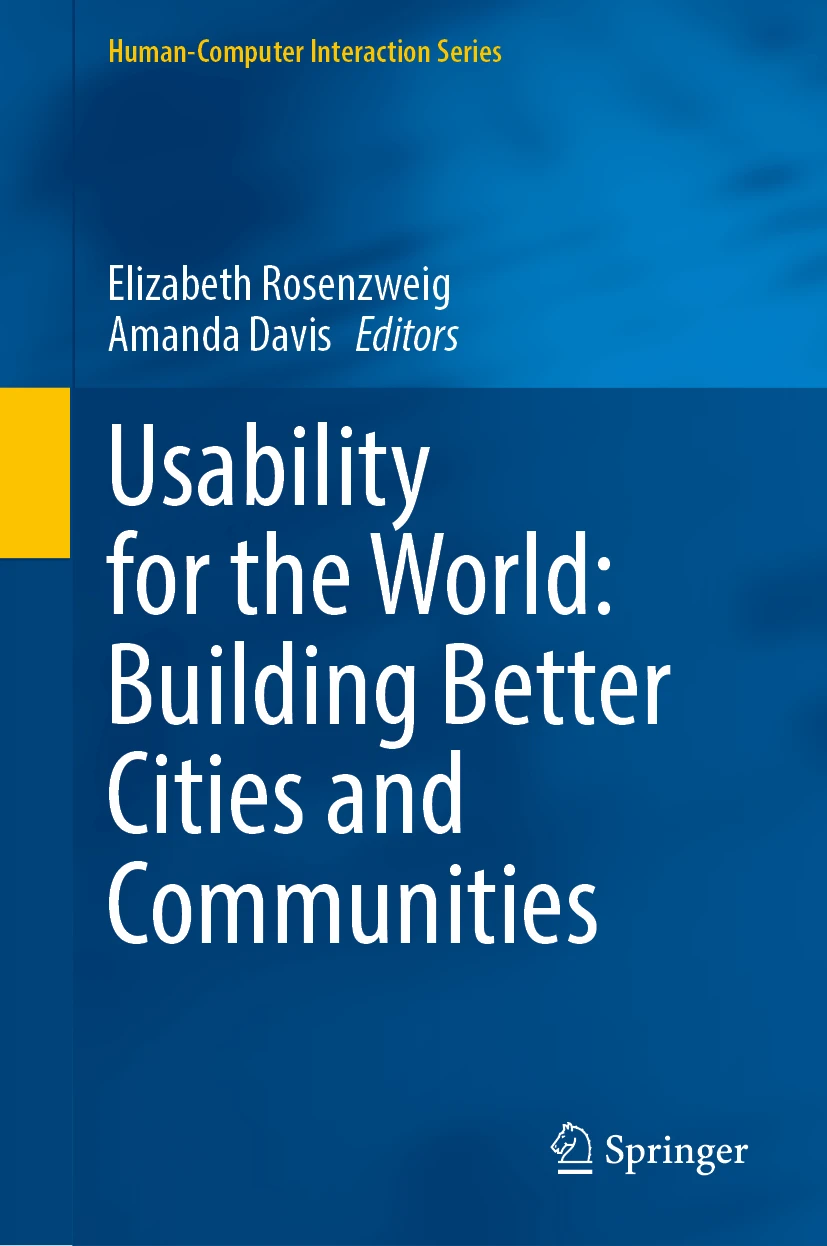
Usability for the World: Building Better Cities and Communities explores how human-centered design can help create sustainable, inclusive, equitable, and resilient cities for all.
About this volume
Usability and human-centered design for urban life
The book examines how usability principles can inform sustainable urban development, public services, civic technology, community design, and more human-centered urban systems.
Through literature reviews, case studies, global perspectives, and future-oriented chapters, the volume connects human-centered design to the practical challenges of creating cities and communities that are functional, sustainable, accessible, and livable.
Editors
Edited by Elizabeth Rosenzweig and Amanda Davis
Elizabeth Rosenzweig is affiliated with World Usability Day and Bubble Mountain in Newton Center, USA. Amanda Davis is affiliated with Experiment Zone. Together, they frame the volume around global usability, human-centered design, and sustainable communities.
About the EditorsChapters
Chapter list
Explore the chapters in Building Better Cities and Communities. Expand each section to read a short overview.
Introduction to Usability for the World: Building Better Cities and Communities
This opening chapter introduces the volume’s central themes and frames usability as an important lens for creating urban environments that are functional, sustainable, equitable, and livable.
At the Intersection of Usability and Urban Sustainability: A Literature Review
This chapter reviews the relationship between usability and urban sustainability, establishing a foundation for understanding how human-centered design can inform sustainable cities and communities.
What’s in It for Me? A Usability Perspective on African Sustainable Cities
This chapter brings a usability perspective to sustainable cities in African contexts, emphasizing how local needs, practical value, and lived experience shape the adoption of urban solutions.
More-than-Human Cities: How to Bring Life-Centered Design Principles to Urban Spaces
This chapter considers life-centered and more-than-human design principles, expanding the conversation beyond human users to broader urban ecosystems.
Exploring Usability of AI Systems in the Global South—Toward Responsible Human-Centered AI for Sustainable Cities and Communities
This chapter examines AI systems in the Global South and considers how responsible, human-centered AI can support sustainable cities and communities.
Embracing Imperfection: The Key to Sustainable UX in Humane Cities
This chapter explores sustainable UX in the context of humane cities, arguing for practical design approaches that acknowledge complexity and imperfection.
Trustworthy Sustainable Cities
This chapter explores trust as an essential dimension of sustainable cities and considers how usability and human-centered design can support trustworthy systems.
Citizen Co-creation
This chapter focuses on citizen co-creation and the role of participatory approaches in developing more usable and responsive urban systems.
Citizen-Centered Cities: User-Centered Design for Cooperative Cities
This chapter looks toward cooperative cities and examines how user-centered design can help support citizen-centered urban futures.
Conclusion: A Call to Action for Sustainable Cities and Global Usability
The conclusion synthesizes the volume’s themes and calls for continued global attention to usability as part of building sustainable cities and communities.
Related volumes
Continue exploring the series
Upcoming volumes invite substantial, chapter-length contributions on Quality Education and Good Health and Well-Being.